
https://chroniclesmagazine.org/web/on-columbus-the-professors-vs-the-people
By MARY GARBER
Mary Grabar, author of Debunking Howard Zinn: Exposing the Fake History That Turned a Generation Against America and Debunking The 1619 Project: Exposing the Plan to Divide America. Her new book, Debunking FDR: The Man and the Myths was published in March 2025. She earned her Ph.D. from the University of Georgia in 2002 and taught college English for 20 years. She is a resident fellow at the Alexander Hamilton Institute for the Study of Western Civilization and Executive Director of Dissident Prof (dissidentprof.com).
Heather Cox Richardson is doing her best to be today’s Howard Zinn in terms of public recognition and politicized history, and it seems to be working. Richardson’s schtick is to point out how ignorant Trump and all Republicans are about history. The Boston College professor does this, as a New York Times profileput it, by bringing a “historian’s confident context” to current events and invoking the authority of “historians.” Recently in her “Letters from an American” Substack, she commenced attacking President Trump, this time for his Columbus DayProclamation.
She objected first to the proclamation’s language which stated that Columbus “carried thousands of years of wisdom, philosophy, reason, and culture across the Atlantic into the Americas—paving the way for the ultimate triumph of Western civilization less than three centuries later on July 4, 1776.” Moreover, she avers that Trump’s historically correct statement that Columbus was guided by a “noble mission: to discover a new trade route to Asia, bring glory to Spain, and spread the Gospel of Jesus Christ to distant lands,” is nothing but “a white Christian nationalist version of American history.”
The historian puts scare quotes around the word “discovered” to downplay Columbus’s feat and then indicted him in not-quite-original fashion: “When Columbus and his sailors ‘discovered’ the ‘New World,’ they brought with them both ideologies and germs that would decimate the peoples living there.” Howard Zinn, similarly, attacked noted historian Samuel Eliot Morison for emphasizing the “heroism of Columbus and successors” and deemphasizing his “genocide.”
Richardson seems to take her statistics from Zinn, too, writing:
Estimates of the number of Native people living in North America and South America in 1490 vary widely, but there were at least as many as 50 million, and possibly as many as 100 million. In the next 200 years, displacement, enslavement, war, and especially disease would kill about 90% of those native peoples. Most historians see the destruction of America’s Indigenous peoples as the brutal triumph of European white men over those they perceived to be inferior.
Zinn in A People’s History of the United States claims there were 75 million natives in North and South America. In fact, the number is between 9 to 16 million. Moreover, the hundreds of tribes in the New World had long been displacing, enslaving, and warring with one another.
By Zinn’s and Richardson’s accounting there was nothing to “discover” except that the natives had civilizations far more advanced than those of the Europeans.
Richardson nonetheless lets us know, “Historians are not denigrating historical actors or the nation when they uncover sordid parts of our past. Historians study how and why societies change.” They see “patterns” and help “us make better decisions.” To get “an accurate picture of how a society works, historians must examine it honestly, seeing the bad as well as the good.”
Richardson is revealing the ego affliction common among post-1960s historian. They imagine they can save “democracy” by interpreting the past. To clarify how this comes about she distinguishes “history” from what she calls “commemoration”:
History is about what happened in the past, while commemoration is about the present. We put up statues and celebrate holidays to honor figures from the past who embody some quality we admire.
Historians, with their expertise, can tell us who is admirable and who is not. And this can change. For example, during the 1920s when attacks on Catholics and immigrants were prevalent, the honoring of Columbus was understandable—maybe necessary. But in the 1960s, when historians focused on the “lives and experiences of Indigenous Americans,” there was a necessary “reckoning.” Italian-Americans can now celebrate their pasta dishes but must give up Columbus.
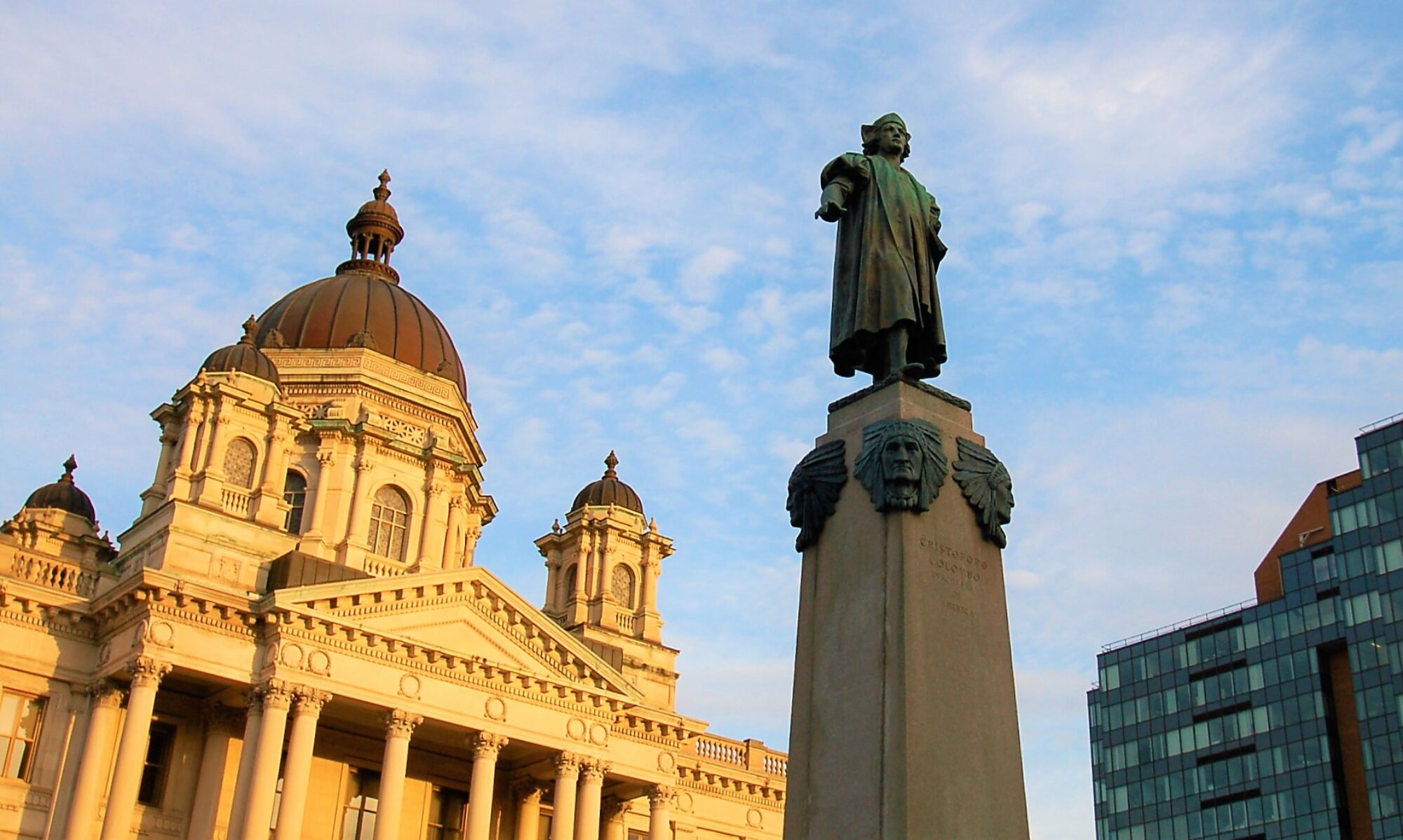
This year on a rainy, cold Columbus Day in Syracuse, New York, I stood with a crowd in Columbus Circle in front of that city’s monument. There was a Knights of Columbus honor guard of four men well past retirement age. There were people whose grandparents and great-grandparents had donated nickels and dimes from wages earned by building railroads, running small businesses, and working in factories and chemical plants to fund the monument, a work by Italian sculptor Lorenzo Baldi.
The 12-foot bronze sculpture of Columbus stands atop a 30-foot pink granite obelisk with bronze masks of Indian people, bronze plaques depicting Columbus’ voyage, and large stone shells that once spouted water and had a reflecting pool. The impressive structure took two years to install and nearly a quarter of a century to fund. Its original dedication in 1934 drew over 15,000 Syracusans and featured a mile-long parade.
Master of Ceremonies at this year’s event was Mark Nicotra, President of the Columbus Monument Corporation, which has been engaged in a five-year fight with the city of Syracuse which seeks to take down the monument. The annual luncheon at the Nicholas Pirro Center hosted about 400 individuals, most of them with Italian surnames. My host, Anthony Ilaqua, a member of the Columbus Monument Corporation Board of Directors, knew many; three of his cousins were at our table.
I was honored to be there and recognized for my book, Debunking Howard Zinn, which begins by debunking Zinn’s Marxist presentation of Columbus as a rapacious capitalist. But there were several other festivities and recognitions in the works. For example, the Pirro Family “Santa Maria” Award was presented by Thomas J. Pirro III to the Assumption Food Pantry and Soup Kitchen. The Joseph J. Pietrafesa Award, named for the monument commission’s chairman in 1934, was presented by Richard Pietrafesa to Kathleen and Daniel Mezzalingua, who carry out the wishes of their daughter, Laurie, the third of their six children who died at the age of 41 in 2009 from breast cancer, by continuing to run the nonprofitfoundation she started. And on it went, celebrating a tradition of volunteerism and community.
A number of Italian-Americans sent video greetings, including writer and producer Adriani Trigiani, Representatives Mike Rulli (Ohio) and Thomas Suozzi (Long Island), the actor Robert Davi, and Saturday Night Live alumnus, Joe Piscopo, who was canceled by Hollywood, but now has a prominent radio show. Piscopo has interviewed such luminaries as Trump, whom he met at a charityevent. Josephine Federico, of the Josephine Federico Music School, played the piano while her students sang, first, the Italian National Anthem and then the American National Anthem.
This is the kind of rich community-supporting activity Mayor Ben Walsh, whose forebears supported the monument, was pleased to quash when he succumbed to woke lunacy in 2020 and called for the monument to be taken down. The Corporation appealed the decision but New York State Supreme Court Appellate Division in 2024 denied the motion. Meanwhile, as Walsh is term-limited, the Letitia James-endorsed candidate, Sharon Owens, accused the Corporation in a recent letter of failing “to recognize the feelings of many African Americans and other people of the African diaspora, including myself, who cannot overlook Columbus’ connection to the perpetration of slavery around the world.” (Africans owned and sold slaves long before Europeans arrived; Columbus never owned a slave.)
The Onondaga Historical Society has applied for a grant from the Mellon Foundation in preparation for placing the disassembled monument in an interpretive park. According to a 2023 announcement, a similar grant was given to Columbus, Ohio for their monument. The “Reimagining Columbus Initiative” will include “community engagement work, research, and design studies to inform decisions on city symbols, new public art, and the fate of the Columbus statue,” which Columbus removed in 2020—after it had been vandalized by rioters. Denver, Colorado also has a project like this underway since their Columbus statue was toppled by George Floyd rioters.
The Columbus Monument Association website warns the citizens of Syracuse that the Mellon Foundation, with “deep pockets and political influence,” is “descending” on their city with a “big grant.” Far from being a way to honor Columbus or the communities that erected these monuments, the Mellon Foundation “is throwing money around the country to ‘reimage’ monuments.”
Such “reimaginings” are conducted by faux historians like Richardson, who sees an impending Third Reich even in the arches to commemorate America’s 250thbirthday, but who apparently does not know when the Declaration of Independence was signed.
Italian-Americans do not deny the right of Indigenous tribes to erect their own monuments. They do not object to the statue of Hiawatha. But in 2020 the Onondaga Nation put out a statement saying that it was “burdensome” for them “to see Christopher Columbus memorialized with a statue.” It was difficult to find “equality and peace” they said “knowing the hardships our ancestors endured as a consequence of his campaign. Our own monuments, beautiful lakes, streams, rivers, and the earth itself, has suffered greatly as a direct result principle of the Doctrine of Discovery.”
In 1934, however, at the dedication ceremony for the monument in Syracuse members of the Onondaga Nation were there to celebrate. On that day, the Syracuse Journal headline read, “Sculptor [Lorenzo Baldi] becomes full-fledged Indian chieftain.” The accompanying photo showed Onondaga Jesse Lyons placing a headdress on the bald and portly Italian. Maybe the Onondagas should look to their own forebears as models instead of such ideologically driven “historians” as Howard Zinn and Heather Cox Richardson.